

Buying a home in Lexington, Kentucky, is one of the most exciting—and most complex—decisions you will ever make. Between fluctuating interest rates, diverse neighborhoods, and evolving lifestyle needs, narrowing down the right property can feel overwhelming. This guide from Team Pannell Real Estate breaks the process into clear, manageable steps so you can move forward with confidence.
Step 1: Clarify Your Lifestyle Priorities Before You Browse
Before opening a single listing, sit down and define what lifestyle means to you in concrete terms. Consider:
- Commute tolerance – Will you be driving to downtown Lexington, the University of Kentucky campus, or a location outside Fayette County?
- Space requirements – Do you need a home office, a large yard for pets, or extra bedrooms for a growing family?
- Activity preferences – Are you drawn to walkable neighborhoods near restaurants and shops, or do you prefer acreage and quiet?
- Future plans – Will this home serve you for three years or fifteen? A shorter timeline favors lower transaction costs; a longer one justifies investing in exactly the right fit.
Writing these answers down creates a personal scorecard you can use when touring homes later in the process.
Step 2: Understand the Lexington Market Landscape in 2026
Knowing where the market stands helps you calibrate expectations. The Lexington housing market is currently characterized as balanced, offering fair conditions for both buyers and sellers.
- Median home values: The average Lexington home value is approximately $288,909 according to Zillow's Home Value Index, reflecting a 5.5% year-over-year increase.
- Median sale price: Redfin data shows the median sale price around $330,000, while Houzeo reports $340,000—slight variations depending on methodology.
- Days on market: Homes in Lexington are moving in roughly 53–63 days on average, indicating a market that is neither frenzied nor stagnant.
- Mortgage rates: As of early 2026, conventional 30-year mortgage rates are hovering in the 6.0–6.5% range, a factor that meaningfully impacts purchasing power.
Understanding these numbers will prevent sticker shock and help you target price ranges realistically.
Step 3: Establish a Realistic Budget and Get Pre-Approved
Figuring out how much home you can afford is the essential first step on your home-buying journey. Use a mortgage calculator—like the one available on teampannell.com—to factor in your down payment, current mortgage rates, insurance, and property taxes.
Pre-Qualification vs. Pre-Approval
These two terms are often confused, but they are different stages:
- Pre-qualification is an informal estimate based on self-reported financial information. It gives you a ballpark number.
- Pre-approval involves a lender verifying your income, assets, credit score, and employment through documentation such as W-2 forms, tax returns, and bank statements. You receive a commitment letter stating the maximum loan amount you qualify for.
A pre-approval letter carries significantly more weight with sellers, because it shows you are a serious, financially vetted buyer. Importantly, a pre-approval amount is a ceiling—not a spending target. Stay within a monthly payment you are genuinely comfortable with.
Credit Score Considerations
Your credit score determines which loan programs are available to you and at what interest rate. FHA loans may accept scores as low as 500 with a larger down payment, while conventional loans typically require 620 or higher. Higher scores unlock better rates, which can save tens of thousands of dollars over the life of a mortgage.
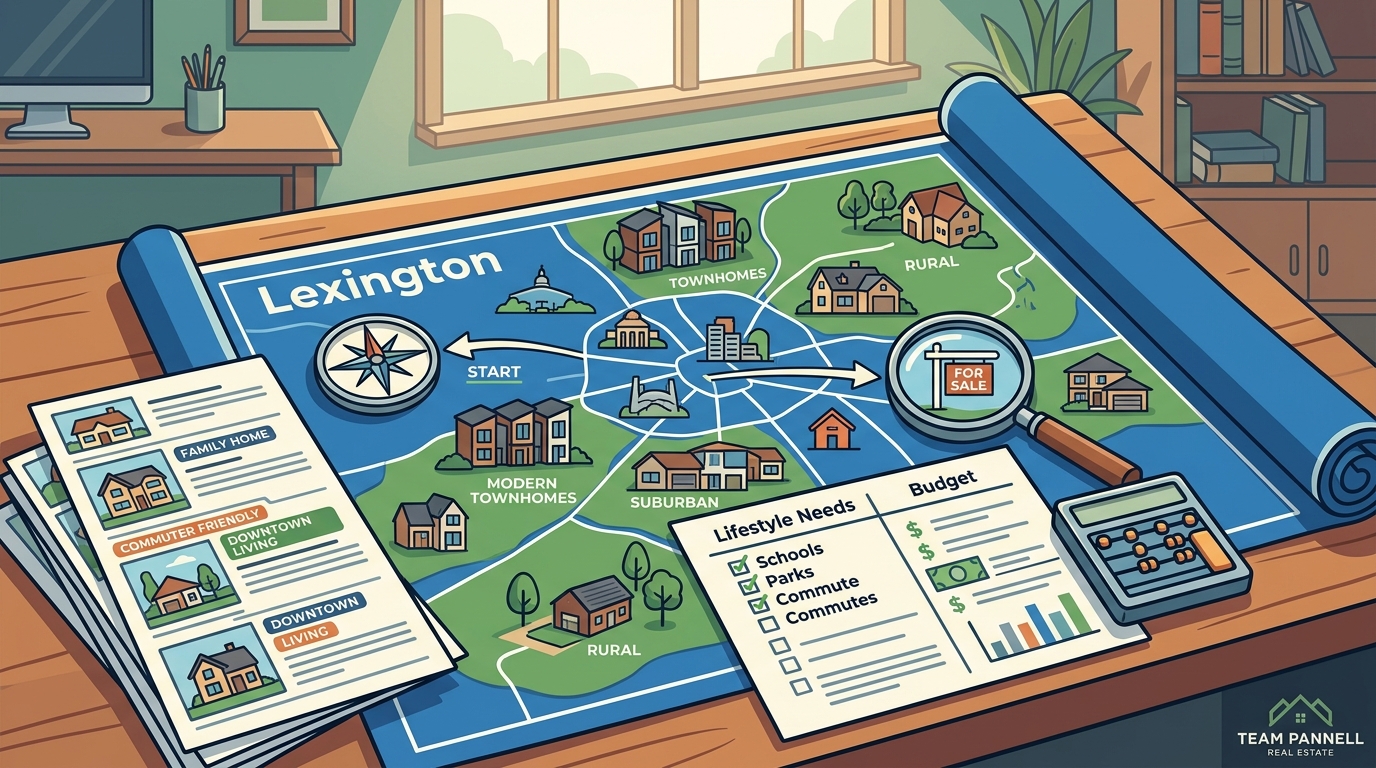
Step 4: Explore Lexington Neighborhoods That Match Your Needs
Lexington's real estate landscape is diverse, with properties ranging from affordable starter homes to luxury estates. Location within the city matters significantly—properties near the University of Kentucky or established neighborhoods command premiums, while emerging areas often offer better value.
Here are a few neighborhood categories to consider:
- Urban walkable (Chevy Chase, Downtown) – Higher price points, shorter commutes, vibrant dining and entertainment. Chevy Chase is known for top safety ratings and attractive housing options.
- Family-oriented suburbs (Hamburg, Beaumont, Masterson Station) – Newer construction, good schools, and community amenities like parks and pools.
- Rural-adjacent (southern and eastern Fayette County) – Larger lots, horse farm views, and a quieter pace of life with reasonable access to city conveniences.
- Up-and-coming areas (Northside, Georgetown Road corridor) – More affordable entry points with potential for appreciation as Lexington grows.
Cross-reference each neighborhood against the lifestyle scorecard you created in Step 1. Team Pannell agents have deep local knowledge of these areas and can provide hyper-specific guidance.
Step 5: Assemble Your Home-Buying Team
Finding a knowledgeable real estate agent is a key part of the homebuying process. An experienced agent helps you navigate the local market, explore financial options, negotiate deals, and recommend trusted service providers like inspectors and title companies.
Your core team should include:
- Buyer's agent – Look for deep local expertise and a track record in the neighborhoods you are targeting. Team Pannell Real Estate has helped thousands of clients find homes in Central Kentucky.
- Mortgage lender – Get personalized rate quotes from at least three lenders. Compare not just advertised rates but the actual interest rates and fees you are offered after applying for pre-approval.
- Home inspector – Line up a qualified inspector early so you can move quickly once you are under contract.
Take time to interview agents and lenders. The right team will save you money, time, and stress.
Step 6: Search Strategically and Tour with Purpose
Once your budget is set and your team is in place, the search begins in earnest. Your agent will search for homes on the local MLS (Multiple Listing Service), surface top picks, and schedule viewings.
Practical Search Tips
- Set up saved searches – Use tools like the Team Pannell property search at teampannell.com to receive automatic alerts when homes matching your criteria hit the market.
- Prioritize your must-haves vs. nice-to-haves – A fourth bedroom might be essential; a built-in bookshelf is not. Being clear about the difference prevents decision fatigue.
- Tour at different times of day – Visit a property during morning rush hour to gauge traffic noise, and again in the evening to see how the street feels after dark.
- Take notes and photos – After touring five or six homes, they start to blend together. Document each visit so you can compare objectively.
Step 7: Evaluate Properties Beyond Curb Appeal
Before falling in love with a home's kitchen or backyard, examine the factors that affect long-term cost and livability:
- Total cost of ownership – Monthly mortgage payments are only part of the picture. Factor in maintenance, property taxes, homeowner's insurance, and any HOA fees.
- Environmental risks – In Lexington, roughly 9% of properties face severe flood risk over the next 30 years, and about 21% have some wildfire risk. Ask your agent about risk data for specific addresses.
- School districts – Even if you don't have children, school quality affects resale value. Lexington is part of the Fayette County Public Schools system with numerous elementary, middle, and high school options.
- Future development – Check the Lexington-Fayette Urban County Government planning department for zoning changes or new construction nearby that could impact property values or quality of life.
Step 8: Make an Offer and Move Toward Closing
When you find the right home, your agent will help you craft a competitive offer. In Lexington's current balanced market, homes are selling for approximately 97.97% of the asking price, meaning there is modest room for negotiation.
Key Steps After Your Offer Is Accepted
- Home inspection – A thorough inspection identifies potential problems such as water damage, structural issues, or needed repairs.
- Appraisal – Your lender orders an appraisal to confirm the home's market value. If the appraisal comes in below your offer price, you may need to renegotiate or cover the difference.
- Loan finalization – Your lender finalizes the mortgage terms. If the inspection and appraisal are satisfactory, you lock in your rate and prepare closing documents.
- Closing – You sign documents, pay closing costs (including any buyer's agent fees you negotiated), and receive the keys to your new home.
In Kentucky, buyer's agent commission fees average about 2.82%. Since the 2024 NAR settlement, buyers negotiate these fees directly with their agent, and sellers may or may not agree to cover them as a concession.
Kentucky First-Time Buyer Assistance Programs
If you are a first-time buyer, Kentucky offers several programs that can reduce your out-of-pocket costs:
- Kentucky Housing Corporation (KHC) Programs – KHC offers mortgage programs that may include down payment assistance. The KHC Regular DAP provides up to $12,500, while the Affordable DAP offers up to $7,500 for lower-income buyers.
- REACH HOME Program – Administered through REACH Inc. in Lexington, this program provides up to $30,000 in forgivable second mortgage assistance for households earning below 80% of the Area Median Income.
- UK Employer Assisted Housing Program – University of Kentucky employees can access up to $15,000 toward a home purchase in designated neighborhoods near campus.
- Lexington Habitat for Humanity & Community Land Trust – These organizations provide permanently affordable homeownership paths for qualifying buyers.
Nearly all Lexington programs require completion of a homebuyer education course. REACH Inc. offers HUD-approved courses locally, and Community Ventures Corporation provides online coursework through eHome America.
Key Takeaways
- Define your lifestyle priorities before browsing listings to avoid wasted time and emotional decision-making.
- The Lexington market in 2026 is balanced, with median sale prices in the $290K–$340K range and homes selling in roughly 53–63 days.
- Get pre-approved—not just pre-qualified—to strengthen your negotiating position.
- Look beyond the house itself: evaluate total ownership costs, environmental risks, and neighborhood trajectory.
- Leverage local assistance programs if you are a first-time buyer; grants and forgivable loans can significantly lower your upfront costs.
- Work with a local expert like Team Pannell Real Estate who knows Lexington's neighborhoods inside and out.
Frequently Asked Questions
How much does a typical home cost in Lexington, KY, in 2026?
Market data varies by source, but the average Lexington home value is around $288,909 per Zillow, while median sale prices range from $310,000 to $340,000 depending on the data provider and time period. Prices differ significantly by neighborhood.
How long does it take to buy a house in Lexington?
From the start of your search to closing, the timeline typically ranges from two to four months. Homes currently spend about 53–63 days on market before going pending, and closing usually takes an additional 30–45 days after an accepted offer.
Do I need a real estate agent to buy a home in Kentucky?
You are not legally required to use an agent, but working without one means managing showings, negotiations, and contracts entirely on your own. An experienced local agent adds value through market knowledge, negotiation skill, and access to off-market opportunities.
What credit score do I need to buy a house in Kentucky?
It depends on the loan type. FHA loans may accept scores as low as 500 with a higher down payment, while conventional loans typically require 620 or above. Higher credit scores help you secure lower interest rates.
Are there down payment assistance programs in Lexington?
Yes. The REACH HOME Program offers up to $30,000 in forgivable assistance, the KHC Regular DAP provides up to $12,500, and the UK Employer Assisted Housing Program offers up to $15,000 for qualifying University of Kentucky employees. Most programs require homebuyer education.
How competitive is the Lexington housing market right now?
Lexington is considered a somewhat competitive, balanced market in 2026. Homes are selling for roughly 98% of list price, and about 67% of listings have experienced price reductions, suggesting buyers have reasonable negotiating power.