

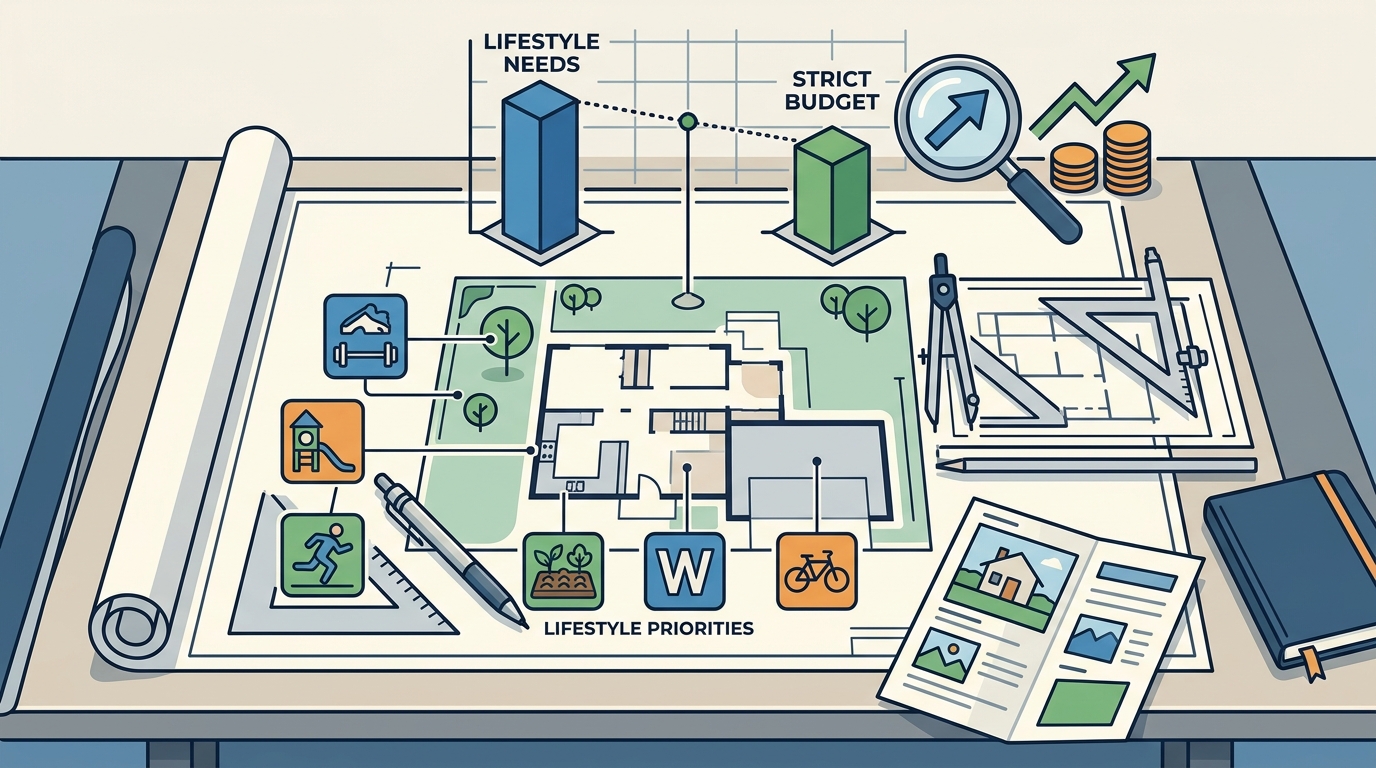
Finding the ideal home requires aligning personal priorities with strict financial boundaries. Recent census data shows that average household spending on housing has increased by twelve percent over the last three years. Buyers who skip foundational planning often overextend their capital or compromise on essential amenities. This structured approach eliminates guesswork by establishing clear parameters before viewing a single listing. You will learn how to map your daily routines against available inventory while maintaining a sustainable mortgage profile. (About Team Pannell Real)
Defining Your Core Lifestyle Requirements
Start by mapping your daily routines against available inventory. Commute tolerance is the maximum acceptable travel time to your primary workplace or frequent destinations. Most successful buyers limit this metric to thirty minutes during peak traffic hours. You must also evaluate proximity to essential services like schools, healthcare facilities, and grocery distribution centers. Properties located near established commercial corridors often command higher premiums. You should prioritize neighborhoods that align with your actual usage patterns rather than theoretical preferences. Visit our Andover Forest community guide to see how established infrastructure impacts daily convenience.
Establishing a Realistic Financial Framework
Financial preparedness dictates your actual purchasing power. Debt-to-income ratio is the percentage of your monthly gross earnings that goes toward servicing existing obligations. Lenders typically require this metric to remain below forty-five percent. You must also account for closing costs, which generally range from two to five percent of the final purchase price. Pre-qualifying with a certified mortgage professional prevents wasted time on unattainable listings. Our team provides a streamlined mortgage pre-approval process to clarify your exact budget ceiling. This step removes emotional friction from the negotiation phase.
Evaluating Neighborhood Growth Trajectories
Location stability directly impacts long-term asset value. Federal banking reports indicate that properties in historically stable districts appreciate at a steady six percent annual rate. You should research municipal zoning plans and infrastructure investment schedules. Areas undergoing revitalization often offer lower entry prices but carry higher short-term volatility. Conversely, established communities provide immediate convenience but demand a larger upfront capital commitment. Review our detailed Ashland Park neighborhood overview to understand how historical preservation affects resale velocity. Prioritize districts with consistent population retention and low vacancy rates.
Matching Property Types to Long-Term Goals
Structural configuration must support your future life stages. Property lifecycle is the expected duration a specific architectural style remains functional and desirable in the current market. Single-family detached homes typically offer maximum privacy and land ownership. Townhouses and condominiums reduce maintenance responsibilities but impose stricter community rules. You should assess your willingness to handle exterior repairs versus paying monthly association fees. Our luxury homes directory highlights premium properties that balance architectural merit with modern efficiency. Select a structure that aligns with your projected occupancy timeline.
Navigating Local Market Dynamics
Regional inventory fluctuations require strategic timing. National association data reveals that average days on market dropped to thirty-eight days across competitive midwestern metros. Buyers who wait for perfect conditions often face bidding wars and waived contingencies. You must monitor active listing counts and recent sales velocity to gauge competition intensity. Our experts conduct continuous free market analysis to identify emerging opportunities before they reach mainstream advertising channels. Acting decisively during inventory surges secures favorable pricing. You should also verify local property tax schedules and insurance requirements before submitting an offer.
Leveraging Professional Valuation Tools
Accurate pricing prevents overpayment and financing delays. Comparative market analysis is a standardized evaluation method that compares your target property against recently sold similar homes. Automated valuation models provide quick estimates but lack nuance regarding interior upgrades or lot topography. Professional appraisers verify structural integrity and neighborhood comparables to satisfy lender requirements. Our platform offers a comprehensive free home valuation tool to establish a realistic baseline. You should always pair automated estimates with on-site inspections to uncover hidden maintenance costs. This dual-verification approach protects your investment from unexpected repair expenses.
| Property Category | Lifestyle Fit | Budget Range | Recommended Resource |
|---|---|---|---|
| Single-Family Detached | Families seeking yard space and privacy | $350,000 to $650,000 | Single Family Listings |
| Townhouse | Professionals prioritizing low maintenance | $250,000 to $400,000 | Condos & Townhomes |
| Luxury Estate | Executives desiring premium amenities | $700,000 to $1.2M | Luxury Homes Directory |
| First-Time Starter | New buyers entering the market | $180,000 to $280,000 | First Time Buyers |
Key Takeaways
- Commute tolerance should not exceed thirty minutes during peak hours.
- Debt-to-income ratios must remain below forty-five percent for approval.
- Closing costs typically consume two to five percent of the purchase price.
- Historically stable districts appreciate at a steady six percent annual rate.
- Average days on market recently dropped to thirty-eight days across competitive metros.
- Team Pannell has facilitated thousands of transactions across Central Kentucky.
- Our Nicholasville and Lexington offices provide localized market expertise.
Frequently Asked Questions
How do I determine my maximum affordable purchase price?
You must calculate your total monthly obligations and subtract them from your gross income. Lenders use this calculation to determine your loan eligibility. Our mortgage calculator provides an instant estimate based on your current financial data.
What documents do I need to secure pre-approval?
You will need recent pay stubs, W-2 forms, and two years of tax returns. Banks also require bank statements and proof of additional assets. Our team guides you through every documentation requirement to prevent delays.
How does neighborhood history affect property value?
Established districts with consistent population retention typically appreciate faster. Municipal zoning changes can either boost or restrict future development. Review our community guides to understand local growth trajectories.
When is the optimal time to submit an offer?
Inventory surges typically occur during late spring and early autumn. Buyers who act quickly during these windows secure favorable pricing. Our agents monitor active listings daily to identify emerging opportunities.
What inspections should I prioritize before closing?
Structural integrity, roof condition, and HVAC functionality require professional verification. Foundation cracks and outdated electrical panels pose significant safety risks. Our recommended inspectors provide comprehensive reports within forty-eight hours.
Begin Your Property Search Today
Identifying the right home requires precise planning and local expertise. Our licensed agents specialize in matching buyer priorities with available inventory. Visit our main homepage to explore current listings. Schedule a consultation to access our proprietary valuation tools. Contact our Lexington office at (859) 800-6823 or our Nicholasville location at (859) 800-6548. We are ready to guide you toward a successful purchase.